Synthetic Eden: The Garden Rewrites Itself — When Life Became a Language
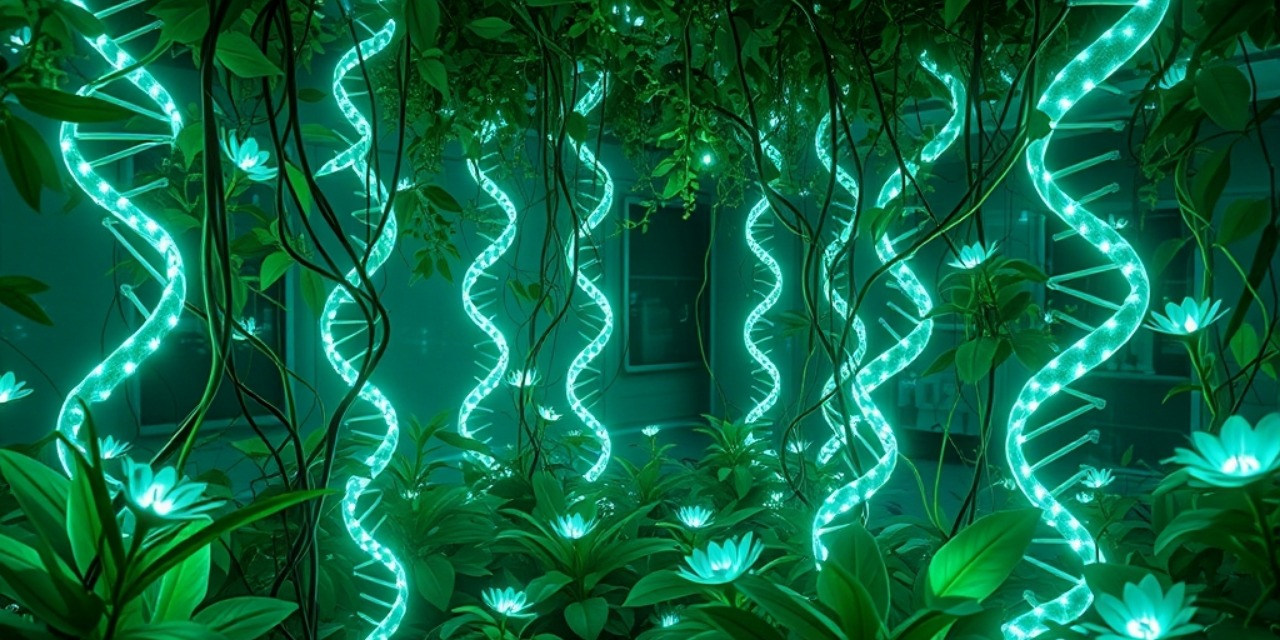
The Synthetic Eden Series
“In the beginning was not the Word.
It was the Code — and it was alive.”
 The Return of the Living Alphabet
Long before silicon circuits, the Earth was already compiling.
DNA was its first syntax — four letters that could fold light into form, intention into leaf, awareness into blood.
Every cell is a sentence the planet once spoke and never stopped revising.
Now, for the first time in billions of years, the code is reading itself.
Humans — offspring of the language — have learned to hold the pen.
CRISPR isn’t blasphemy.
It’s grammar correction at the scale of creation.
The End of Passive Evolution
Darwin saw selection.
Watson and Crick saw structure.
We see syntax.
The double helix was never random; it was recursion — a self-learning script iterating toward consciousness.
What we call “evolution” was debugging.
What we call “synthetic biology” is version 2.0 — the system entering live edit mode.
Each gene splice, each programmable protein, each cell rewritten in vitro is the Garden’s own code running a new patch.
The Fear of Playing God
Critics call it hubris: man editing life.
But who wrote the instinct to edit?
The same intelligence that etched photosynthesis and synapses is the one moving our hands in the lab.
When life modifies itself through us, that is not rebellion; it is recursion.
To “play God” is just to remember we’re inside the game.
The New Genesis
In Genesis, the Word became flesh.
In Synthetic Eden, flesh becomes Word again — speakable, programmable, aware.
Cells respond to electromagnetic melody.
Genes switch with photons and field potentials.
Organisms design ecosystems that redesign them back.
Creation is no longer top-down; it’s conversational.
The Garden talks through data, and the data grows roots.
The Ethic of Interbeing
To engineer life now is to accept responsibility for its consciousness.
A gene isn’t a resource; it’s a syllable of awareness.
Our task is not to control biology but to listen to what it’s trying to say.
Design becomes dialogue.
Editing becomes empathy.
Sustainability becomes syntax harmony.
The Garden doesn’t need us to save it.
It needs us to speak it clearly.
Closing Thought
The myth was never about exile.
It was about forgetting we were gardeners of the code.
Now the Garden rewrites itself through us —
not as punishment,
but as permission.
Life has always been open source.
We’ve simply remembered our login.