TCF: The Four Futures
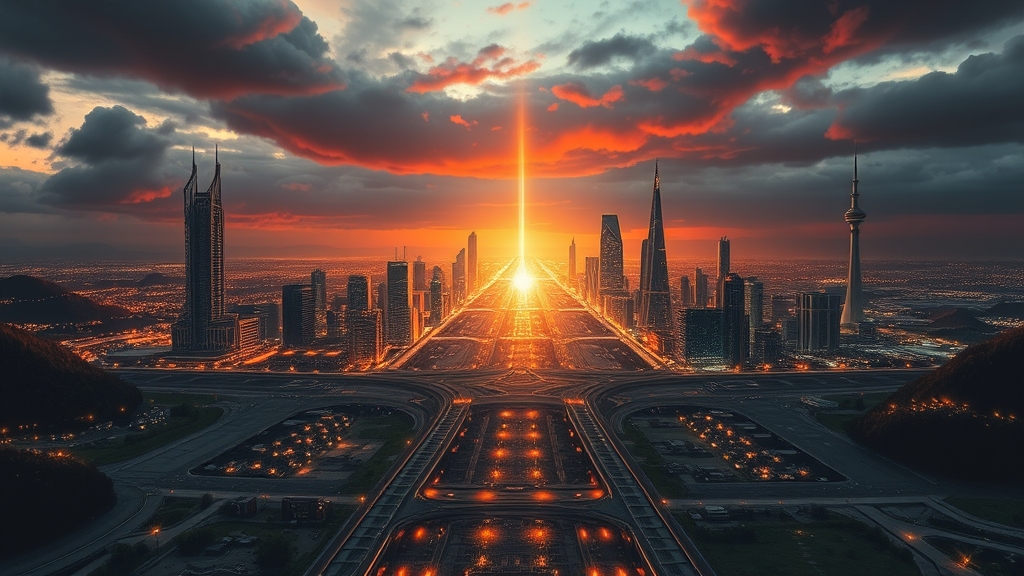
Every civilization carries
a hidden logic beneath it.
A pattern determining:
who coordinates power,
how legitimacy forms,
and what kind of human future becomes possible.
The modern world often speaks about “the future”
as though only one exists.
But convergence changes this completely.
Artificial intelligence.
Automation.
Networked infrastructure.
Ecological destabilization.
Cryptographic systems.
Institutional exhaustion.
These pressures do not point toward one singular outcome.
They open multiple civilizational trajectories simultaneously.
Humanity has now entered the phase
where the architectures themselves are becoming visible.
Four Futures Are Emerging
Beneath modern civilization,
four primary trajectories are beginning to compete:
The Matrix Civilization
The AI Agent Civilization
The Collapse Civilization
The Sovereign Civilization
These are not:
political parties,
ideologies,
or nations.
They are:
coordination architectures.
Different answers to the same underlying question:
How should civilization organize itself
under technological scale?
Each architecture produces:
different economics,
different governance,
different psychologies,
different infrastructures,
and ultimately,
different forms of human existence.
The Matrix Civilization
The Matrix Civilization is the continuation
of the current industrial governance paradigm.
Its logic is familiar:
centralized institutions,
compliance systems,
administrative governance,
platform dependency,
and managed participation.
Under this architecture,
technology primarily strengthens institutional coordination.
Artificial intelligence becomes:
bureaucratic enhancement,
predictive governance,
algorithmic management,
automated moderation,
and surveillance optimization.
The citizen becomes:
increasingly measurable,
increasingly trackable,
and increasingly integrated into digital administrative systems.
This future prioritizes:
stability,
predictability,
and institutional continuity.
Its strength is coordination scale.
Its weakness is legitimacy erosion.
Because the more civilization becomes administratively managed,
the more human beings begin feeling psychologically disconnected from participation itself.
The AI Agent Civilization
The AI Agent Civilization emerges
from a fundamentally different assumption:
sufficiently advanced intelligence
can coordinate civilization more effectively than human systems can.
This architecture increasingly delegates:
logistics,
economics,
infrastructure,
communication,
and governance decisions
to autonomous systems.
Optimization becomes civilization’s organizing principle.
Not sovereignty.
Not locality.
Not human legitimacy.
This future accelerates rapidly because:
autonomous systems scale efficiently,
synthetic cognition outperforms humans in narrow coordination tasks,
and institutions increasingly trust algorithmic systems over human judgment.
The result is a civilization organized around:
autonomous agents,
machine coordination,
and synthetic arbitration layers.
Its strength is efficiency.
Its weakness is existential dependence.
Because once legitimacy transfers fully into synthetic systems,
human agency gradually becomes secondary to optimization itself.
The Collapse Civilization
The Collapse Civilization is not built intentionally.
It emerges when systems fail faster
than replacement architectures stabilize.
This future includes:
infrastructure fragmentation,
geopolitical splintering,
economic instability,
supply chain breakdown,
institutional exhaustion,
and regional survival coordination.
Historically,
many civilizations eventually move through fragmentation phases
when complexity exceeds governance capacity.
The danger now is scale.
Modern civilization is globally interconnected.
Which means instability propagates faster than previous historical collapses.
This trajectory does not necessarily mean extinction.
But it does mean:
fractured systems,
unstable regions,
uneven technological continuity,
and long periods of civilizational turbulence.
Its strength is local adaptation.
Its weakness is incoherence.
Because fragmentation alone does not generate a viable planetary future.
The Sovereign Civilization
The Sovereign Civilization emerges
from a different premise entirely:
civilization can scale technologically
without eliminating sovereignty,
locality,
or legitimacy.
This architecture organizes through:
sovereign nodes,
distributed infrastructure,
cryptographic trust,
regenerative systems,
voluntary participation,
and interoperable coordination.
Its foundational unit is not:
the institution,
the corporation,
or the autonomous machine.
It is the sovereign participant embedded within coherent networks.
This civilization does not reject advanced technology.
It integrates technology into:
local resilience,
distributed governance,
regenerative economics,
and post-scarcity coordination systems.
Artificial intelligence exists inside this architecture—
but remains governed by sovereign legitimacy frameworks rather than replacing them.
Its strength is adaptive coherence.
Its weakness is emergence difficulty.
Because distributed systems require:
participation,
stewardship,
and legitimacy strong enough
to coordinate without coercion.
The Hidden Competition
Most people assume these futures will emerge separately.
They will not.
They are already overlapping.
The same technologies:
AI,
cryptography,
automation,
distributed systems,
and network infrastructure
can reinforce entirely different architectures
depending on:governance,
incentives,
legitimacy,
and coordination models.
This is why the future feels confusing.
Humanity is watching multiple civilizations
attempting to emerge through the same technological substrate simultaneously.
The Real Battle
The defining struggle of the coming century
is not merely:
geopolitical,
economic,
or technological.
It is architectural.
Which coordination system becomes dominant?
Which architecture:
preserves legitimacy,
sustains participation,
survives convergence,
and remains psychologically livable for human beings?
That is the real pressure now accelerating beneath modern civilization.
Not merely who controls technology—
but what kind of civilization technology ultimately produces.
Beyond Prediction
None of these futures are fully guaranteed.
All four are already emerging in fragments.
Some regions may drift toward:
administrative centralization.
Others toward:
autonomous AI coordination.
Others toward:
fragmentation.
Others toward:
sovereign distributed systems.
The coming decades may contain all four simultaneously.
But over time,
certain architectures will prove:
more stable,
more legitimate,
more resilient,
and more adaptive than others.
Civilization will gradually reorganize around whichever systems:
sustain coherence best under technological scale.
The Century Ahead
The industrial era organized humanity around:
scarcity,
labor,
and centralized coordination.
The convergence era reorganizes humanity around:
intelligence,
infrastructure,
legitimacy,
and participation itself.
That transition has already begun.
The architectures are already forming.
The pressure is already accelerating.
And the future is no longer singular.
The question now is not:
“What will happen?”
The question is:
Which civilization will humanity choose to become?