TFG: Small Enough To Feel Human Again
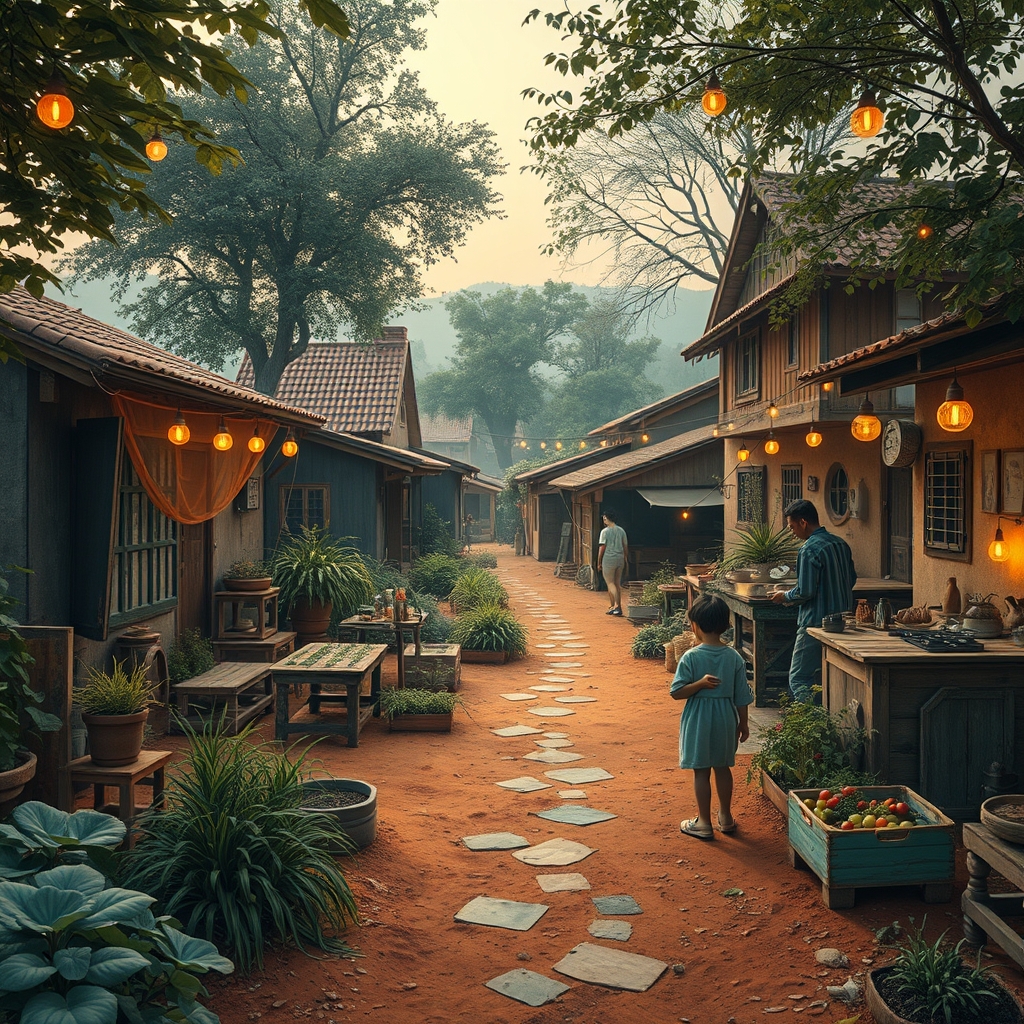
The old world kept getting larger.
And somewhere along the way,
human beings stopped feeling real to one another.
Industrial civilization worshipped scale.
Bigger cities.
Bigger supply chains.
Bigger institutions.
Bigger systems too vast for any individual to meaningfully touch or understand.
Efficiency became the highest virtue.
Locality became inconvenience.
And slowly,
human life became increasingly mediated through structures
too large to feel human anymore.
Most people now live inside systems
they cannot influence,
cannot repair,
and often cannot even perceive clearly.
Food arrives from unknown places.
Decisions are made by distant institutions.
Communities dissolve into transient movement.
Attention becomes global while belonging disappears locally.
The result is a strange form of psychological compression:
constant connection,
paired with profound dislocation.
The first gardens move differently.
Not backward.
Not anti-technological.
Simply closer to human scale again.
Close enough:
to recognize the people growing the food,
to understand where water comes from,
to participate in maintaining systems directly,
and to feel the consequences of choices in real time.
This changes consciousness more than most people realize.
Because intimacy creates responsibility naturally.
Small systems also reveal things large systems conceal.
Waste becomes visible.
Energy use becomes tangible.
Seasonal shifts become impossible to ignore.
Relationships matter more.
Repair matters more.
Trust matters more.
Human beings begin interacting with reality again
instead of abstractions layered endlessly on top of it.
The old world called this inefficiency.
But perhaps hyper-scale was the inefficiency all along.
Massive systems requiring enormous extraction
simply to maintain emotional emptiness at industrial volume.
Meanwhile,
smaller coherent ecosystems often generate:
stronger relationships,
deeper resilience,
healthier nervous systems,
lower dependence,
and more meaningful forms of abundance.
Not because they reject complexity.
But because they remain relational enough
to stay alive.
This does not mean every future community becomes tiny or isolated.
The next civilization will still contain networks,
advanced systems,
shared infrastructure,
and planetary coordination.
But the foundational unit changes.
From anonymous mass systems
to coherent local ecosystems connected intelligently together.
This is a very different architecture.
In coherent environments,
human beings begin recovering capacities
industrial civilization quietly eroded:
patience,
attention,
interdependence,
practical stewardship,
emotional presence,
and the ability to participate directly
in sustaining life.
These capacities do not return through ideology alone.
They return through lived rhythm.
This is why the first gardens matter so deeply.
They are not merely productive spaces.
They are recalibration spaces.
Places where scale contracts enough
for human perception to function properly again.
Where meals regain context.
Where children see systems working visibly around them.
Where local trust becomes practical instead of theoretical.
Where people remember:
life was never supposed
to feel permanently outsourced.
And perhaps this is one of the deepest shifts now beginning beneath the surface:
civilization moving from scale without intimacy
toward interconnected systems
still small enough
to feel human again.
Not disconnected villages.
Not isolated survivalism.
But living networks of coherent places
where technology serves relationship
instead of replacing it.
The future may still become vast.
But its foundations will likely feel surprisingly local.
A garden.
A shared kitchen.
A workshop humming late into the evening.
Children carrying herbs between neighbors.
Water collected after rain.
People learning each other’s rhythms again.
Small enough to recognize one another.
Small enough to participate meaningfully.
Small enough
for life to become tangible again.