TFG: The Places Where Life Returns
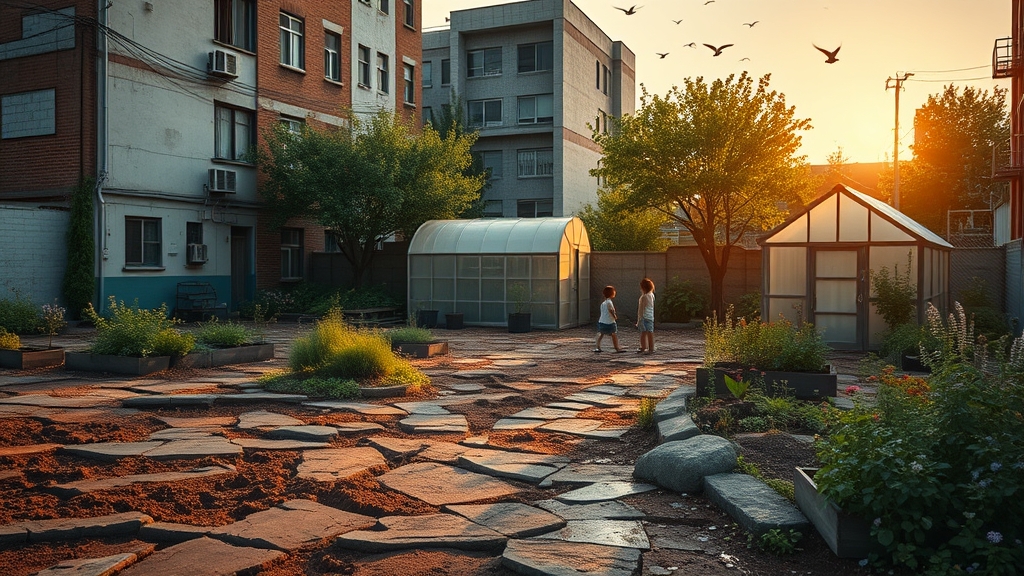
The old world leaves scars.
But life has never stopped trying to heal them.
There are places where the system begins losing its grip.
Not through revolution.
Not through collapse.
But through gradual reanimation.
Vacant lots becoming food corridors.
Dead soil darkening with compost and fungal life again.
Pollinators returning after years of absence.
Water moving slower through restored land.
Neighborhoods growing quieter as people rediscover local rhythm.
The changes often appear subtle at first.
Almost forgettable.
Until enough of them begin gathering together.
Industrial civilization taught humanity
to separate itself from the processes that sustain life.
Food arrived wrapped in plastic.
Water emerged from hidden infrastructure.
Energy appeared through distant systems no one touched directly.
The living world became abstraction.
Consumption replaced relationship.
And over time,
many environments stopped feeling alive at all.
Not dead.
Just disconnected from themselves.
But life responds quickly when conditions change.
So does the human nervous system.
A single coherent space can alter perception dramatically.
A functioning garden beside a shared kitchen.
A courtyard where children recognize herbs by smell.
A greenhouse glowing during winter storms.
Rainwater collected instead of wasted.
Birdsong returning after years of mechanical noise.
These things affect people more deeply than statistics ever could.
Because coherence is felt before it is understood intellectually.
This is one of the reasons local regeneration matters so much.
Not only ecologically.
Emotionally.
Civilizationally.
Places shape perception.
And perception shapes what people believe is possible.
When environments become extractive,
human beings unconsciously internalize extraction as reality itself.
But when environments begin generating visible life again,
something changes internally.
The future becomes easier to imagine.
The first gardens are often built in damaged places.
Not because they are ideal.
But because damaged places are everywhere now.
Abandoned infrastructure.
Fragmented communities.
Exhausted land.
Disconnected neighborhoods.
Yet this may become one of the unexpected strengths of the transition:
coherence does not require perfection to begin.
Only enough living pattern
to start reorganizing the surrounding field.
This is also why regeneration spreads differently than industrial expansion.
It does not move by force.
It moves through attraction.
People encounter a coherent place
and immediately feel the difference.
The body relaxes.
Conversation slows.
Attention deepens.
The environment itself begins teaching.
Not through ideology.
Through experience.
And once enough people experience environments like this,
industrial normality starts appearing increasingly unstable.
Artificial.
Needlessly hostile to life.
The contrast becomes difficult to ignore.
A thriving local ecosystem beside a collapsing extraction economy
reveals more than arguments ever could.
It creates emotional proof.
The first gardens therefore become more than food systems.
They become:
nervous system sanctuaries,
social anchors,
local trust generators,
ecological classrooms,
and physical demonstrations
that post-scarcity civilization is not merely technological.
It is relational.
Sensory.
Embodied.
Alive.
There are already places across the world
where this transition has quietly begun.
Small pockets of regeneration forming beneath the larger architecture of decline.
Some are rural.
Some urban.
Some mobile.
Some deeply hidden.
Most remain disconnected from one another for now.
But the pattern is spreading.
And perhaps this is how civilization changes most truthfully:
not when the old world collapses completely,
but when enough places begin feeling more alive
than the systems they are replacing.
Because once life starts returning somewhere—
truly returning—
people remember.
Not abstractly.
Physically.
They remember:
human beings were never meant
to live this disconnected from the living world.
And once that remembrance enters a place,
the soil changes.
The rhythm changes.
The future changes with it.