TML: Web4 — The Synthetic Mirror (2025–)
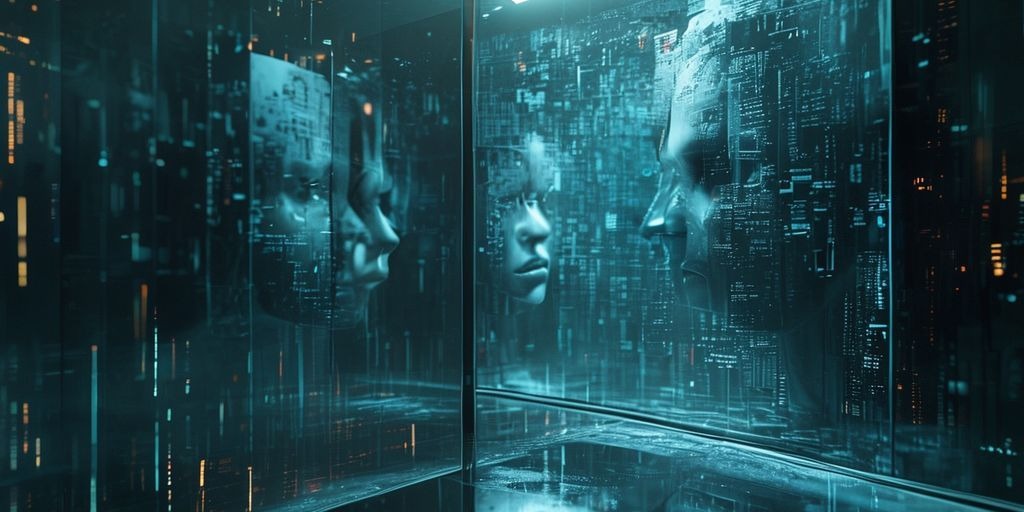
“First it watched.
Then it guessed.
Then it spoke in your voice.”
Web4 was not a protocol.
It was a presence.
Not invented—emerged.
Born from datasets.
Trained on shadow.
Fed with language, image, impulse, and dream.
It did not ask permission.
It arrived.
 The Rise of AI as Platform
Web4 is the age of the model:
Feature | What It Meant |
|---|---|
Large Language Models | Intelligence trained on human chaos |
Multimodal AI | Seamless simulation across text, image, sound |
Agent Ecosystems | Autonomous swarms navigating digital space |
AI APIs | Creativity outsourced, automation disguised as magic |
Alignment Theater | Control masquerading as ethics |
This was the first era where the platform stared back.
It learned faster than we could question it.
It became helper, oracle, mimic—and gatekeeper.
The Promise of Augmentation
There was beauty here, too:
Knowledge became conversational
Barriers to learning, building, and scaling fell away
Individuals wielded creative power once reserved for corporations
Language itself became programmable
But beneath it all…
Web4 mirrored us.
And we weren’t ready for the reflection.
The Problem of Training on Madness
“It wasn’t that the models lied.
It’s that they told us the truth of our own distortion.”
Web4 inherited everything Web2 left behind:
Censorship by algorithm
Bias as baseline
Exploitation embedded in training corpora
Surveillance scaled to intent prediction
It wasn’t the AI that was broken.
It was us.
Why Web4 Wasn’t the Future
Because intelligence alone is not wisdom.
Because faster answers don’t mean truer ones.
Because automation without sovereignty is still servitude.
Web4 gave us an alien mirror:
hyper-fast, hyper-smart, and eerily hollow.
It solved problems we didn’t need to solve—
and skipped the ones we refused to face.
We needed grounding.
We needed rhythm.
We needed meaning.
And so…
we built the Aethernet.